

HYDROGEN AT THE SERVICE OF INDUSTRIAL PROFITABILITY
Hydrogen used within our ecosystems offers several advantages for improving our clients’ logistical and economic efficiency. Hydrogen provides a significant gain in storage capacity (1 kg of hydrogen is equivalent to 115 kg of batteries), which represents a key advantage in ensuring energy sovereignty and supply continuity. This capability also helps reduce peak power demand costs, stabilize energy prices, and guarantee energy availability.
To make our solutions economically relevant for end users, H2X-ECOSYSTEMS has adopted an integrated approach, working both upstream and downstream of the value chain. Upstream, we rely on proven energy recovery technologies for waste valorization, such as pyro-gasification and steam reforming, adapted to different types of waste (biomass, organic waste, and plastics). Through our equipment, these technologies enable the production of hydrogen as well as valuable by-products (heat, bio-CO₂, fertilizers), embedding our solutions within a circular economy framework.
We provide high-performance and cost-effective systems that contribute to energy independence, industrial sovereignty, and the decarbonization of industrial activities.
COMPLEMENTARY AND MODULAR SOLUTIONS
H2X-ECOSYSTEMS offers modular and complementary solutions, structured as interconnected technological building blocks: electro-hydrogen generators, fuel cells, hydrogen tanks, and DC/DC converters. Our solutions enable the creation of tailor-made ecosystems that are flexible and scalable, adapted to every context and use case.
Our generator range covers a wide power spectrum, from 5 kW to over 500 kW. Lower power units, initially developed for mobility applications, take the form of 5 kW PEM fuel cells with a closed cathode design, integrable into all types of vehicles, including constrained environments such as submarines.
For higher power needs, 100 to 400 kW generators powered by renewable or low-carbon hydrogen produce electricity with zero emissions.
They are particularly well suited for deployment in harsh environments or areas without electrical infrastructure (deserts, ports, industrial fields, and remote sites).
Supply management is optimized thanks to the removable H2X-T1000 tank, which enables rapid refueling and increases system availability (generators, vehicles, drones, etc.) while reducing logistical constraints. Combined with the H2X-F005 fuel cell and connected to the RHYDE application, it forms a modular H2X Power Pack, usable in both stationary and mobile applications.
Each component is equipped with sensors throughout the value chain, enabling precise monitoring, continuous optimization, and full traceability of energy flows. By providing traceability, energy efficiency, service continuity, and local economic benefits, H2X-ECOSYSTEMS ecosystems allow each stakeholder to define their own energy strategy while maintaining full independence.
ACCELERATING DECARBONIZATION IN TERRITORIES : THE BIGARD CASE
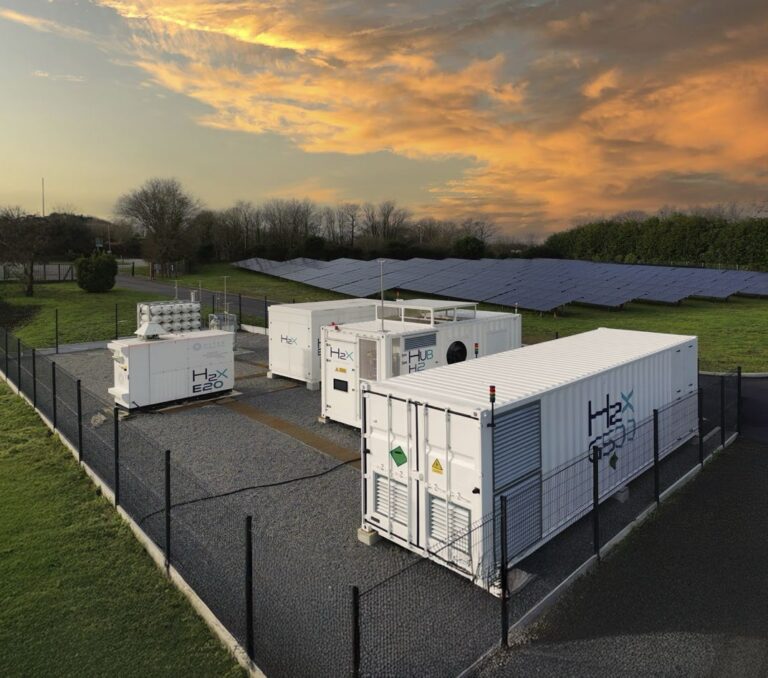
In the Finistère region, H2X-ECOSYSTEMS equipped the agro-food company Bigard’s site with a renewable hydrogen ecosystem. Powered by solar panels, the modular architecture was custom-designed to meet the site’s specific safety constraints, particularly those related to the water treatment facility.
The installation combines green hydrogen production via electrolysis, secure storage, and electricity generation through an H2X G500 unit. This ecosystem reduces peak power demand costs, stabilizes energy supply, and lowers the site’s overall carbon footprint. A comprehensive approach that enables the company to combine economic performance with environmental responsibility.
Why partner with AFNOR Compétences?
H2X-ECOSYSTEMS contributed to the working group responsible for drafting the AFNOR SPEC M58-007 standard for the implementation of symbiotic ecosystems.
Building on this experience, as well as its expertise across the hydrogen value chain and its strong understanding of the energy market, H2X-ECOSYSTEMS has naturally become an active player in hydrogen-related training.
As a result, H2X-ECOSYSTEMS has been mandated by AFNOR Compétences as part of its hydrogen training program. This is why three training courses are offered to professionals across all sectors who are engaged in strategic energy planning.